Planning
2026 Catch-Up Contribution Limits: 401(k) and IRA
After 50, you can contribute up to $32,500 to a 401(k) and $8,600 to an IRA in 2026. Here’s how catch-up limits work at every age.
There are a lot of questions about retirement savings and investments.
With regards to savings, you need to know: How much to save (did you know that some people save too much)? How much savings you will you need for retirement? Where should you save? Should you save pre-tax (traditional, SEP & Simple IRAs, 401ks, 403bs, 457s, 529s, HSAs, etc…) or after-tax (Roth IRAs and 401ks)? How do you find more money to save?
And, there are probably even more questions about investments: What should you invest in (stocks, bonds, real estate, funds)? How should your investments change over time? How do your financial values impact your investment strategy? What is the ideal asset allocation for you? What should you do when the market swings wildly?
See below for articles covering the answers to these questions and more.
After 50, you can contribute up to $32,500 to a 401(k) and $8,600 to an IRA in 2026. Here’s how catch-up limits work at every age.
The top 10% wealthiest retirees have about $3.0M in net worth. See what the top 1% have, and where you stand.
Use 6–8% while you’re saving for retirement, 5–6% while you’re withdrawing. The right rate depends on your asset mix and timeline.
Learn how CalSavers applies to California workers and employers, including automatic Roth IRA enrollment, payroll deductions, and benefits.
The contribution order for retirement accounts can affect how much your money compounds tax-free. Here’s how to prioritize for tax efficiency.
Money is not all about numbers and analysis. Emotions can help and hurt your financial security. Learn how to be an emotionally intelligent investor.
Think you qualify for the 0% capital gains tax rate? Your other income may have already eaten that space. Here’s why, plus the 2026 brackets.
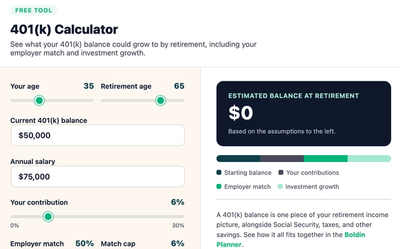
See your projected 401(k) balance in seconds, employer match included, using 2026 contribution limits. Free calculator, no email required.
James Choi’s investing model suggests your stock allocation should depend on income, savings, and future earnings, not just age.
Roth conversions move pretax retirement savings into a tax-free Roth account. You pay taxes now to avoid them later. Here’s when it’s worth it.
Hidden mutual fund fees can cost you thousands over time. Learn every expense ratio, sales load, and 12b-1 fee, and how to minimize them.
The 2026 Roth 401k limit is $24,500, plus catch-up for age 50 and up. See the new rules, including who has to use Roth for catch-up starting this year.
31.9 million forgotten 401(k)s hold an estimated $2.1 trillion. Search the National Registry, DOL database, PBGC, and more — all free.
When markets feel uncertain, asking the right questions matters. These 10 questions can help you review your financial plan and make smarter decisions during vo…
Review the long term trajectory of the S&P 500, see how long historic recoveries have taken, and learn how to protect your financial security.
Index funds charge as little as 0.03% annually and outperform most actively managed funds over time. Here’s how they work.
Most retirement portfolios look diversified by account. What they hold across all accounts is a different question. Here’s how to check.
Real estate can generate income, hedge inflation, and diversify your portfolio. Here are 8 ways to do it, from REITs to rental property.
The best asset allocation strategy for you today? As you age? Is age the best way to determine investment strategy? Get answers.
Most advisors who allow crypto cap it at 1% to 5% of a portfolio. See how volatility, RMDs, and estate risk shape the right amount.
Learn the pros and cons of different Roth conversion timing strategies and how to choose the right approach for your retirement plan.
Skip the stuff. These last-minute books for financial peace of mind can change how someone thinks about money, time, and what really matters.
Inheriting money? Won the lottery? Here is what you need to know for long-term financial security after experiencing a sudden wealth event.
Get insights for the best way to use your money. What are the pros and cons of paying off mortgage vs. investing?
Take financial wellness into your own hands and do it yourself retirement planning: easy, comprehensive, reliable.