Budgeting & Spending
How to Manage Your Money in Retirement: 10 Rules That Work
Retirement changes how money works: fewer earning years, more tax decisions. These 10 rules cover withdrawals, spending, and what shifts over time.
Your retirement plan is a roadmap to your future, but like all plans, it is likely to evolve and change over time.
The economy will not behave exactly as you have anticipated and your own life and goals will also change over time.
And, the best retirement planning goes way beyond your savings and investments. Numerous other factors like Social Security, when you stop work, your longevity, home equity, debt, taxes, income sources, inflation, spending, healthcare costs, lifestyle choices, and more may actually represent greater value or be more important than your savings with regards to your overall financial wellness.
Retirement changes how money works: fewer earning years, more tax decisions. These 10 rules cover withdrawals, spending, and what shifts over time.
Here’s every retirement milestone mapped to the exact birthday: catch-up contributions, the Rule of 55, Medicare, Social Security, and RMDs.
How to sort your holdings into 8 asset classes, spot concentration risk, check against your risk profile, and catch drift or cash drag early.
Financial mapping can lead you to better financial decisions and outcomes, turning scattered goals into a plan that holds up against risk.
Under-saving is a math problem you can still fix. Over-saving can cost years you won’t get back. Here’s how to tell which one you’re doing.
Vanguard just paid billions for Altruist to scale advisors. Boldin’s CEO argues the bigger opportunity is scaling what you can do yourself.
Life satisfaction often rebounds after midlife, staying relatively high in your 60s and early 70s. Here’s how to prepare for a fulfilling retirement.
Visa income minimums, Medicare gaps, and double taxation: the real costs of retiring abroad, and how to plan around them before you commit.
Long-term care can run past $129,000 a year. Healthcare can top $345,000 for a couple. Here are the retirement costs people tend to miss.
Specific, research-backed ways to help you deal with financial stress and money worries. Start building real confidence today.
Poor financial decision making costs more than money. Learn to slow down, cut bias, and choose with a clear plan.
Debt advice often stops at interest saved, but you can see whether paying off debt faster changes your retirement date using planning tools.
The average 401(k) millionaire hits that mark around 59. See the moves that build wealth fastest after 50.
Consumption smoothing is how you keep your standard of living stable across a lifetime of income changes, career shifts, and retirement.
Gray divorce makes up 36% of U.S. divorces, up from 9% in 1990. See the pros and cons of divorce after 50, and how to protect your retirement.
Planning mistakes add up. Claiming Social Security at 62 alone cuts your benefit by 30% for life. But most can be corrected if caught early.
Erin Moriarity shares her take on Social Security timing, building a retirement income floor, and when to stop going DIY and hire a CFP.
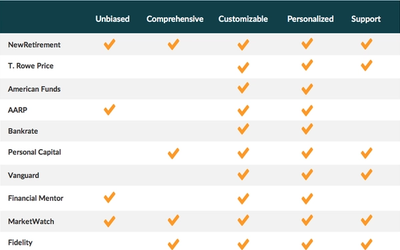
See how Boldin, Fidelity, Vanguard, AARP, and 6 more retirement calculators stack up on accuracy, customization, and price.
Only 15% of Americans managed to ace this 8-question personal finance index quiz. Find out which knowledge gaps cost you the most.
Risk comprehension is the weakest financial literacy domain in 2026, and age doesn’t fix it. See why six in 10 Americans struggle with financial decisions.
Boldin vs. ProjectionLab, MaxiFi, Empower, Right Capital, and 9 more — compared on taxes, Roth strategy, Social Security, and cost.
When tuition stops, it frees up $30,000 to $80,000 a year. Most households don’t have a plan for that money. Here’s how to put it to work.
Some 44% of Americans seriously consider retiring abroad. Greece ranked #1 in 2026. See costs, visa requirements, and where demand is going.
A retirement plan isn’t about restriction. It’s what turns limited resources into real confidence. Here’s why the constraint is the point.
Take financial wellness into your own hands and do it yourself retirement planning: easy, comprehensive, reliable.